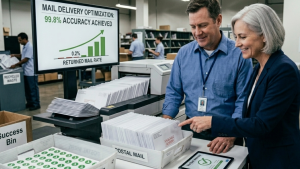

Why Parcel Accuracy Matters?
Common Challenges in Parcel and Package Management
- Incorrect or incomplete addresses
- A missing apartment number or an outdated street name sends a package back or into exception handling.
- Lack of standardization
- Different systems store addresses in different formats. One may use abbreviations, another full street names, and another may omit secondary information entirely. This makes matching and validation harder.
- Manual processes slow down production
- Teams often fix addresses by hand, reprint labels, or re-key shipping data. That doesn’t scale when you move from hundreds to tens of thousands of parcels.
- Tracking and visibility gaps
- Operations teams may struggle to see where parcels are in the process: pre-label, in transit, out for delivery, or returned. Without that visibility, it’s hard to respond quickly when something goes wrong.
How Good Parcel Management Solves these Problems
![Delivery person in a blue polo hands a boxed package to a smiling man in a light blue polo in front of a modern house with a brick pillar and mailbox (address 123 Oak Ave).] ,](https://anchorcomputersoftware.com/wp-content/uploads/2026/06/good-parcel-management-1024x585.jpg)
What Manage Parcels and Packages does
- Use MaxCASS OS to validate parcel addresses before shipping, using USPS® address verification, DPV® and other reference data.
- Standardize address formats to improve compatibility with postal and carrier systems.
- Use MaxPresort OS to align parcel preparation with postal and carrier standards and to support postal compliance software requirements.
- Generate reports in each solution and follow the job flow process with Product Monitor to provide a clear overview of the project.
- Connects with optional add-on tracking to provide better parcel tracking visibility.
Key Benefits for Businesses
Several benefits consistently emerge when organizations adopt structured parcel management solutions like this.
Fewer Returned Parcels
When addresses are validated and standardized in advance, more parcels arrive at their destinations on the first attempt. That reduces the volume of packages that come back to the mailroom as undeliverable.
Lower Operational Costs
Returns, reprints, and reships all cost money. Better parcel address accuracy reduces that waste. Automation also cuts the labor needed for manual checking and relabeling, helping teams handle higher volumes without adding staff.
Better Customer Satisfaction
Timely, accurate delivery is one of the simplest ways to build trust. When customers receive their parcels on time and don’t have to track down lost items, they are more likely to stay engaged and come back.
Faster Mailroom Workflows
Integrated validation and mail prep automation let parcels move more quickly from data file to label to outbound truck. With clear rules and fewer exceptions, the same mailroom can handle more volume in less time.
Improved Visibility and Tracking
Linking parcel preparation to tracking data gives teams a clearer view of their pipeline. They can see which shipments are in progress, which have been delivered, and which may need attention. That supports better service to internal teams and external customers.
Simple Best Practices for Managing Parcels and Packages
Over three decades working with mailers and shippers, I’ve seen a few basic practices make an outsized difference:
- Don’t wait for returns to tell you an address is wrong. Use shipping-accuracy tools and USPS data to verify addresses at the source.
- Align address formats so CRM, order entry, and shipping tools all speak the same language. This reduces mismatches and failed lookups.
- Use mail prep automation to handle repetitive tasks like label creation, presort preparation, and basic quality checks. Keep humans focused on exceptions and oversight.
- Watch for patterns in undeliverable parcels or late deliveries. Use that feedback to improve address capture and processing rules.
- A little knowledge about DPV®, presort, and carrier expectations goes a long way. When staff understand why data quality matters, they are more careful at every step.