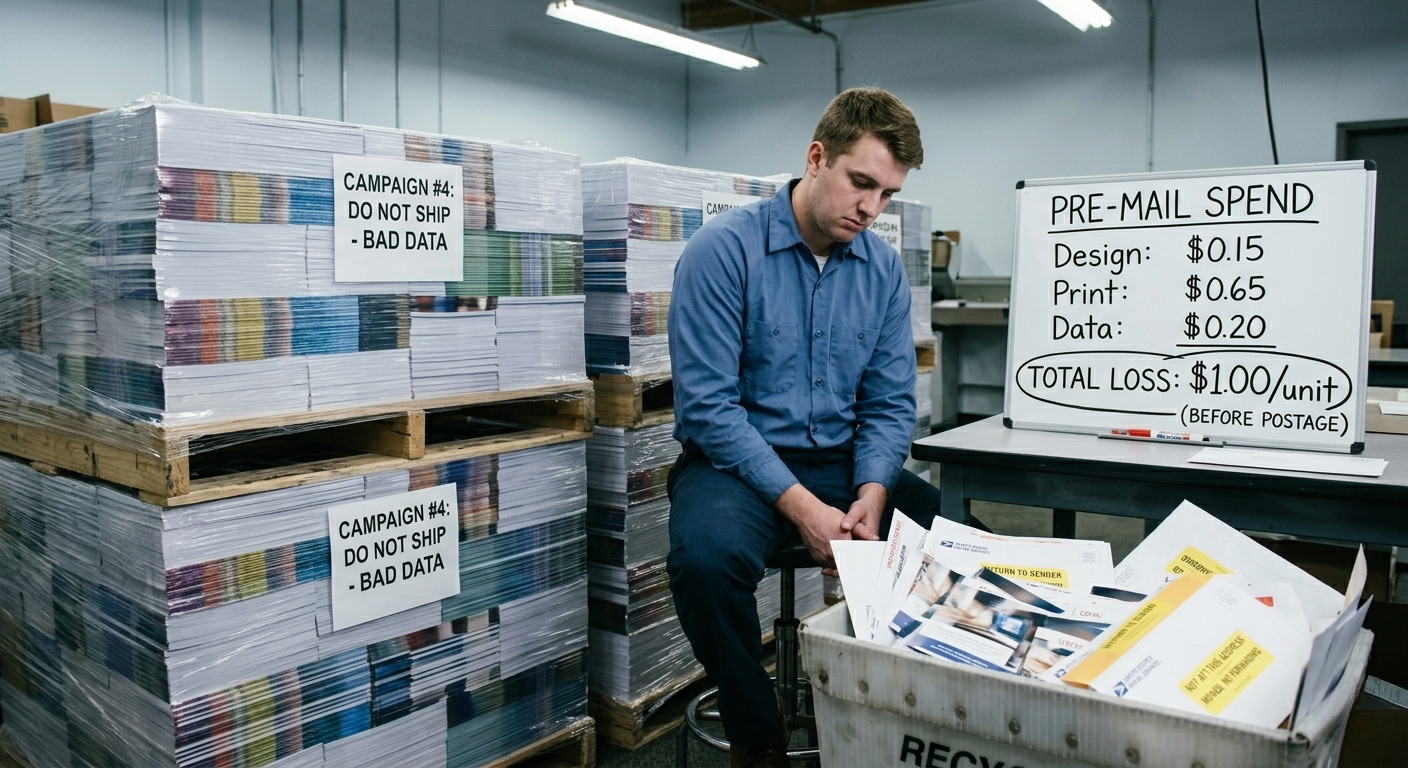
Warehouse worker in a blue shirt sits among stacked mail bundles on pallets; signs read 'Campaign #4: Do Not Ship - Bad Data' and a whiteboard shows pre-mail spend costs.

Why your “Clean” List Still Creates Return Mail

A mailing list can look perfectly fine on paper and still burn a hole in your budget. The catch is that “good data” isn’t just about valid addresses; it’s about whether those records survive the journey from your CRM to the mail house without getting corrupted or lost along the way. That silent friction is where too many direct mail campaigns quietly lose time, money, and momentum.
 
Many teams treat list hygiene as a one-time project. They run a cleanup before a big campaign, check a compliance box, and then move on. That may feel efficient, but it leaves the real issue untouched: new bad data keeps entering the system every day, and yesterday’s clean file doesn’t protect tomorrow’s mail.
 

Where does the Breakdown Happen?

The weak spot is usually not one dramatic failure. It’s the accumulation of small ones: misspelled streets, old apartment formats, duplicate contacts across systems, and records that were never standardized the same way twice. Once a file moves through multiple platforms, those little inconsistencies turn into undeliverable mail, wasted postage, and reporting that no one fully trusts.

That’s why address quality needs to be part of the workflow, not beside it. A practical address validation step helps reduce obvious errors before they become production problems, but the real value comes when that check is part of the normal path your data already takes. If it only happens during a one-time cleanup, the system simply goes back to letting new problems in.
 
This is where a lot of “we already cleaned the list” thinking falls apart. A clean file at one point in time is not the same thing as a clean pipeline. New records enter through web forms, imports, manual edits, vendor feeds, and CRM syncs. If those sources are not governed the same way, the list starts drifting again almost immediately.

What does a Reliable Process Looks Like?

A sturdier model starts earlier and repeats more often. That means validating addresses at capture, standardizing them before segmentation, deduplicating before production, and suppressing records that should not go out at all. If one of those steps only happens “when we remember,” the workflow isn’t controlled; it’s hopeful.
 
For direct mail teams, that difference matters because the downstream costs are very real. A missed apartment format can turn into a returned piece. A duplicate record can inflate volume and distort response math. A stale contact can create a poor customer experience and waste postage. The issue is not just data cleanliness; it’s operational trust.
 
A practical address validation layer helps reduce obvious errors before they become production problems. Still, the real value comes when that step is embedded into the way the team already works. That is the difference between a system that occasionally looks good and one that remains dependable under volume.

Why Data Suppression Matters?

Another area many teams underplay is suppression. A deceased suppression process is not just about cleanliness; it’s about reducing waste, protecting brand reputation, and avoiding the awkwardness of sending mail that should never have gone out in the first place. In regulated or relationship-sensitive industries, that kind of error is not a small miss. It is a trust problem.
 
And suppression is only one piece of the larger hygiene picture. Many organizations have decent acquisition practices but weak maintenance practices. That means they’re good at capturing new records, but not as disciplined about keeping the database healthy over time. The result is predictable: the file looks bigger, but not necessarily better.
 
Anchor Software’s broader focus on mailing efficiency and data quality reflects that reality. In direct mail operations, the goal is not to make the process look fancy on a diagram. It’s to make it hard to break when the list changes, the source systems multiply, or the campaign deadline gets tight.

Why does it Matter to Operations?

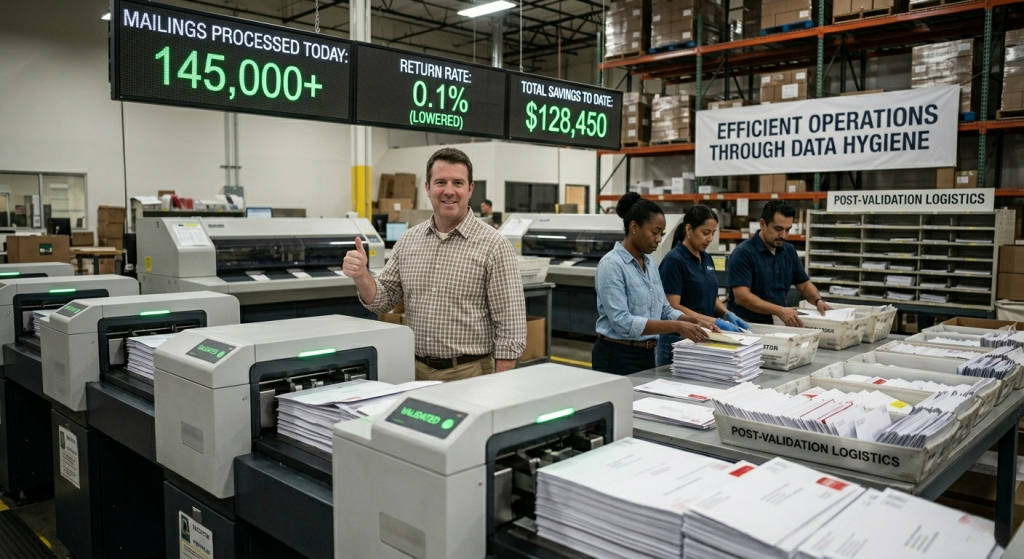
Staff sorting mail at a busy processing facility, one worker giving a thumbs-up near large mail printers and stacks of envelopes.
 
Marketing directors care about campaign performance. Operations teams care about deadlines, postage, and rework. Data teams care about quality rules and integration logic. A solid list hygiene process has to serve all three, or it becomes another half-finished initiative that looks good in a demo and falls apart under volume.
 

That’s the real test: can your workflow keep working when the list changes, the source systems multiply, and the deadline doesn’t move? If the answer is no, the issue isn’t the channel; it’s the foundation underneath it. That foundation is usually where teams underinvest, especially when they assume a single cleanup job will protect them for the rest of the year.

A lot of mailing pain comes from handoffs. Data moves from one system to another, is transformed, and then imported again, and every transition is a chance for quality to degrade. The more handoffs you have, the more opportunity there is for a record to lose context, formatting, or consistency. By the time the file reaches production, nobody wants to be the person explaining why a supposedly clean list still produced avoidable returns.

The Hidden Cost of Duplicates and Drift

Duplicates are especially deceptive because they can look harmless at first. One extra record here, one repeated household there; that does not seem like a crisis in isolation. But across a full campaign cycle, duplicates can inflate volume, distort segmentation, and muddle matchback analysis. If the same customer is represented more than once, the campaign is no longer measuring what the team thinks it is measuring.

Data drift creates a similar problem. Even when the original standard was good, live systems do not stay still. New fields get added, source rules change, manual corrections happen, and outside vendors format records differently. Unless the workflow continues to enforce standards, the database slowly becomes a patchwork of slightly different versions of the same truth.
 
That’s why recurring hygiene matters more than heroic cleanup. A one-time project can help you recover from a messy start, but it cannot guarantee stability. Stability comes from repeated controls that are tied to the actual path of the data. That is where the process becomes operational instead of aspirational.

What do Better Practice Looks Like?

A stronger workflow usually has three layers. First, real-time or near-real-time checks at capture. Second, batch hygiene before segmentation or export. Third, suppression and deduping before mail close. That combination reduces surprises and gives teams a clearer picture of what they’re really sending.

The order matters. Capture-stage validation catches obvious issues before they spread. Pre-production hygiene catches records that changed since entry. Final suppression and deduplication ensure the file is ready for actual mailing, not just theoretically acceptable. If you skip one of those layers, the workflow can still function, but it becomes far easier for errors to slip through.
 
This is also where many teams get trapped by their own success. They build a good pilot, the numbers look great, everyone is confident, and then the old export routine comes back through the side door. Six months later, returns are up, response analysis is muddy, and nobody remembers which step was supposed to clean what. That is not really a software issue. It is an operating model issue.

What to Ask Next?

The useful question is not “Did we clean the list?” It’s “How does the list stay clean after the first campaign?” That shift changes everything. It forces teams to think about recurring validation, suppression, deduping, and postal readiness as part of the pipeline, not as a rescue operation at the end.


If the goal is fewer returns, better deliverability, and less waste, the solution is rarely another one-off cleanup. It is a process that makes bad data harder to sneak through in the first place. That may sound less exciting than a big transformation project, but it is usually what works in the real world.
 
A good direct mail system does more than process records. It protects margin, reduces waste, and keeps the operation predictable. That’s the part teams should care about, because predictability is what keeps mailing programs useful when volumes rise, deadlines compress, and nobody has time to chase down preventable errors.

Welcome

Welcome to Anchor Software, where we transform your customer communication strategy. With our cutting-edge address validation and data quality software, we ensure that every communication is not just delivered, but delivered accurately and effectively. Our commitment to excellence extends beyond data management – we specialize in crafting personalized messages that resonate with your audience, driving unparalleled engagement and loyalty.

Recent Post

Privacy Overview

This website uses cookies so that we can provide you with the best user experience possible. Cookie information is stored in your browser and performs functions such as recognising you when you return to our website and helping our team to understand which sections of the website you find most interesting and useful.